Economy & Politics
U.S. Government Reopens After Record 43-Day Shutdown
After a historic 43-day shutdown, President Donald Trump approved a temporary funding measure that reopens the U.S. government and ends the longest budget impasse in the nation’s history. The stopgap bill provides funding until January 30, leaving room for further negotiations early next year. The shutdown significantly weighed on the economy. According to the Congressional Budget Office, it reduced GDP growth by roughly 1.5 percentage points this quarter. Airlines faced revenue losses due to flight disruptions, food assistance for millions of low-income families was delayed, and federal employees went weeks without pay. With back pay now on the way, the focus shifts to restoring government services and stabilizing the broader economy after weeks of interruption.
Trump Eases Tariffs as Approval Drops Over Cost-of-Living Concerns
Trump’s approval rating stands at 38%, with only 26% approving of his handling of the cost of living. In response, he has shifted focus to affordability and rolled back many of the tariffs he previously imposed. He reduced tariffs on around 200 food products—including beef and coffee—which benefits exporters such as India, previously hit with tariffs of up to 50%. The administration also lowered tariffs on most coffee bean imports, helping U.S. roasters, though Brazil, the world’s largest coffee producer, still faces steep tariffs of around 40% and gains little from these changes.
Switzerland Reaches Major Deal to Reduce U.S. Tariffs
Switzerland and the United States have reached a significant agreement to resolve their months-long tariff dispute. Under the deal, U.S. punitive tariffs on Swiss imports will be reduced from 39% to a maximum of 15%, eliminating the competitive disadvantage Switzerland faced compared with the EU and EFTA countries. In exchange, Switzerland commits to facilitating at least USD 200 billion in direct investments in the U.S. by 2028, largely from the pharmaceutical industry, along with companies such as Pilatus and Stadler Rail. Switzerland will also lower certain tariffs on selected U.S. agricultural products, though officials say these involve “non-sensitive” items. The White House states that USD 67 billion of the planned investments should materialize by 2026 and claims the agreement will help reduce the U.S. trade deficit with Switzerland, which stood at USD 38.5 billion in 2024. However, the Swiss government has not publicly framed the deal in those terms. While business groups welcome the tariff cut, they warn that uncertainty remains high, the strong franc continues to weigh on exporters, and new tariffs could reappear. The new 15% rate is not yet in force, as both countries must still adjust their customs systems and convert the political understanding into a binding agreement.
Nvidia’s Strong Results Calm Markets but Bubble Fears Linger
Nvidia’s latest quarterly earnings far exceeded expectations, easing market worries after weeks of volatility. With revenue up 62% year-on-year to USD 57 billion and a bullish forecast of USD 65 billion for the next quarter, investors took the results as confirmation that the AI boom remains intact. Nvidia’s influence is enormous: its market value exceeds USD 4.5 trillion, and its performance shapes global tech sentiment and equity markets. CEO Jensen Huang maintains that the world is entering a virtuous cycle of AI adoption, supported by massive demand for Nvidia’s chips, record margins above 73%, and rapidly expanding infrastructure projects in regions like Saudi Arabia. Despite U.S. export restrictions to China, Nvidia expects sales to grow further, driven by new data-center partnerships and surging demand for high-performance hardware. However, concerns persist. Major investors have trimmed positions, and the rapid, often debt-funded expansion of AI infrastructure—over USD 100 billion invested by data-center operators in recent quarters—raises questions about sustainability. The complex web of cross-investments between Nvidia, cloud providers, and AI startups fuels fears of overheating. According to a recent survey, more than half of institutional investors believe AI stocks may already be in bubble territory.
China’s Economy Faces Mounting Pressure as Growth Weakens
China’s latest October data show a deepening economic slowdown marked by weak consumer spending, falling prices, and declining investment. Despite crowded shopping districts, many Chinese—especially younger people—are spending cautiously amid high youth unemployment and wage cuts. Retail sales grew only 2.9% year-on-year, well below expectations. The country remains stuck in a long deflationary cycle: consumer prices have been flat for ten months, and producer prices have dropped for more than thirty consecutive months. Corporate profits and private investment are shrinking, with overall investment down 1.7% so far this year—a record decline. Industrial capacity is under-used, and real estate prices, sales, and construction continue to fall despite earlier government support efforts. Companies, particularly automakers like BYD, are slashing prices to maintain sales, yet even aggressive discounts no longer prevent declining volumes. Beijing wants to reduce excess industrial capacity, but large-scale factory closures risk worsening already fragile employment, making local governments reluctant to act. Boosting domestic demand would require stronger social support, such as childcare subsidies or higher pensions, but financial constraints limit government action. With tax revenues falling and pension funds projected to run dry by 2035, authorities face severe budget pressure. China’s policymakers confront difficult trade-offs as economic momentum continues to weaken.
Markets increasingly expect December Fed rate cut
Shortly after expectations for 2025 Federal Reserve rate cuts faded, JPMorgan now predicts the first reduction could come as soon as next month. This shift aligns with swaps markets, which now price an 80% chance of a quarter-point cut, up sharply from under 30% just a weak earlier. The change follows weak consumer sentiment reports and the Fed’s Beige Book, noting softer spending, slight job declines, and only high-income households maintaining demand. Meanwhile, electricity costs have surged to a two-year high and are set to rise further in 2026, raising pressure on consumers as industrial and AI-driven power usage grows.
Warren Buffett Steps Back as Berkshire Hathaway Enters a New Era
Warren Buffett, 95, announced he will no longer write Berkshire Hathaway’s annual shareholder letters and will accelerate donations to his family foundations, marking another stage in the company’s leadership transition. Buffett, who transformed Berkshire from a failing textile firm into a USD 1 trillion conglomerate, will hand operational control to long-time deputy Greg Abel by year-end while remaining chairman. Buffett plans to retain a significant portion of his Berkshire Class A shares until shareholders gain full confidence in Abel, amid concerns reflected in a recent 12% stock drop. At the same time, he converted shares worth about USD 1.3 billion into donations to four family foundations, explaining he wants his children to manage these funds during their lifetime. His letter mixes personal reflections, praise for his late partner Charlie Munger, and warnings to corporate leaders about soaring executive pay and the risks of aging managers staying in power unchecked. Buffett reassures investors that Berkshire remains strong, well-prepared for crises, and aligned with long-term shareholder interests, even if future returns may be modest compared to the past. He ends on a reflective, optimistic note: still working daily, grateful for his longevity, and urging shareholders to choose role models wisely.
Berkshire Hathaway Inc
Markets
Global Overview
Global equities ended November slightly positive at +0.3%, but headline performance masked significant divergences beneath the surface. Health Care stood out as the clear leader with a strong +8.2%, followed by Consumer Staples and Communication Services, both benefiting from defensive positioning. Materials and Energy also contributed positively, supported by stable commodity demand. In contrast, more cyclical and growth-oriented areas struggled. Technology retreated –4.6%, reflecting renewed valuation concerns and profit-taking after strong earlier gains. Consumer Discretionary (–1.9%) and Industrials (–1.3%) also lagged, indicating caution toward sectors reliant on economic momentum. Overall, November was characterized by rotation rather than broad market expansion — resilience in defensive sectors balanced out weakness in growth and cyclicals, resulting in only a modest net gain for global equities.
Europe
November delivered a relatively quiet month for European equities, with performance varying widely across countries and resulting in a modest +0.4% gain for the MSCI Euro. Spain stood out as the strongest market at +3.1%, followed by Italy at +1.7% and France, which ended nearly flat at +0.1%. Germany lagged slightly at –0.2%. Outside the Eurozone, Switzerland performed notably well with a +4.4% gain, while the UK advanced a more modest +0.5%.
Bond markets were broadly stable. The German Bund held at 2.7%, while French and Italian 10-year yields remained unchanged at 3.4%. Spanish 10-year yields ticked up from 3.1% to 3.2%, whereas Swiss 10-year government bonds stayed at 0.2% and UK Gilts held steady at 4.4%.
North America
U.S. equities started November on shaky ground, pressured by the prolongedgovernment shutdown, stretched valuations in mega-cap tech, and a firm stance from the Federal Reserve. Consumer confidence fell to its weakest level since 2022, and volatility surged early in the month. Momentum reversed later as the market increasingly priced in the likelihood of a December rate cut, triggering a rebound that left the S&P 500 slightly positive at +0.25%. Mid- and small-cap stocks outpaced large caps, rising 2% and 3% respectively. Sector performance diverged sharply: Health Care surged roughly 9%, while Technology lagged amid renewed caution surrounding AI-linked names.
Fixed income showed broad strength, with most U.S. bond indices advancing. Treasury yields eased as rate-cut expectations firmed, pushing the 10-year yield back below 4%.
In Canada, equities rose solidly through the month, with the S&P/TSX Composite up 3.9% and the S&P/TSX 60 ahead 3.6%. Sector returns varied widely: Materials rallied about 14.6%, while Information Technology slid over 7%. Commodity-linked benchmarks were strong, including a 3.3% gain in base metals and a standout 16% rise in gold-focused equities.
Latin America
Major Latin American equity markets delivered solid gains in November, extending their year-to-date resilience. The S&P Latin America BMI advanced 5.1%, supported by improved risk sentiment, firm commodity prices and continued interest in emerging-market cyclicals.
Among individual countries, Brazil rose 6.1%, helped by stronger domestic growth expectations and supportive monetary conditions, while Mexico gained 1.7%, continuing a more moderate but steady upward trend. Chile outperformed the region with a 7.4% increase, driven by momentum in copper-linked names and improving inflation indicators. Overall, Latin America benefited from a constructive macro backdrop and investor preference for markets with relatively attractive valuations.
Asia-Pacific
Asian equities paused in November after seven months of gains, with the S&P Pan Asia BMI (USD) slipping 2%. Performance varied by sector: Communication Services and Technology — leaders year-to-date — saw notable pullbacks of about 6%, while Energy gained roughly 3%. Thailand remained the weakest market at –4% (YTD –6%), and pressure in Technology dragged Korea (-4.9%), China (-3.1%) and Taiwan lower. Indonesia was a bright spot, rising around 1.3%.
Japan extended its winning streak to an eighth month, with the S&P Japan 500 up ~1%, supported by strong small-cap performance (+5%). Most sectors advanced, led by Utilities, Real Estate and Energy, while Communication Services and Technology slipped.
Elsewhere, global risk appetite softened. Australia fell around 3% and New Zealand declined slightly, with Financials and Technology weighing heavily on the S&P/ASX 200, while Health Care and Consumer Staples outperformed at roughly +2%.
Fixed income showed a divided picture. USD-based Asian indices made modest progress, while local currency bonds slipped due to currency weakness. China high yield underperformed –1% amid renewed default concerns. Japanese bonds fell, with the S&P Japan Bond Index down -1% as markets priced in a possible BoJ rate hike. In Australia and New Zealand, bond indices retreated -1% as inflation trends reinforced expectations for further tightening rather than cuts.
Learn more on LCI Research
Equity Performance of selected Countries
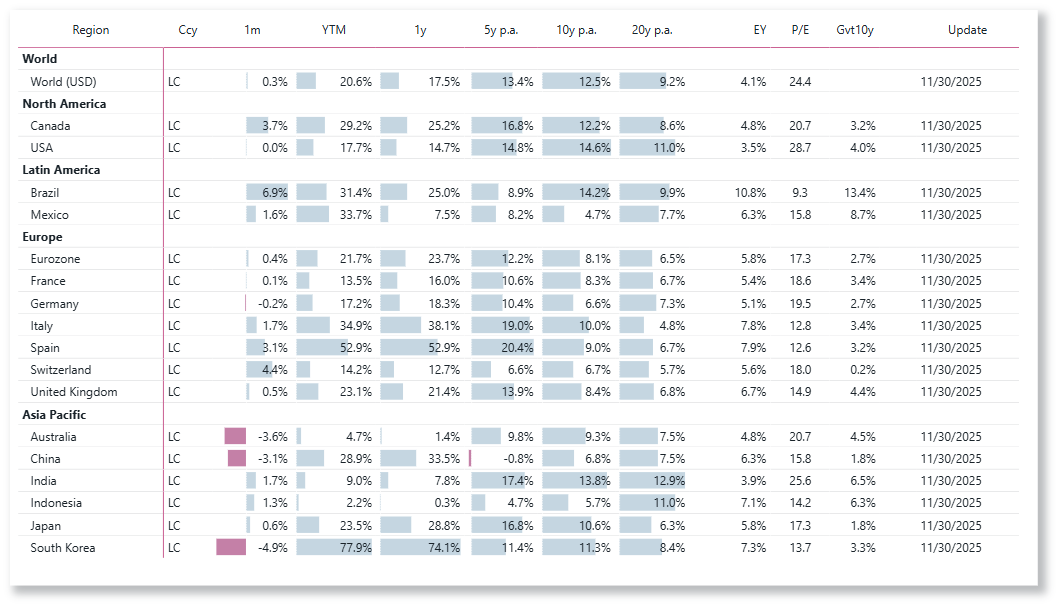
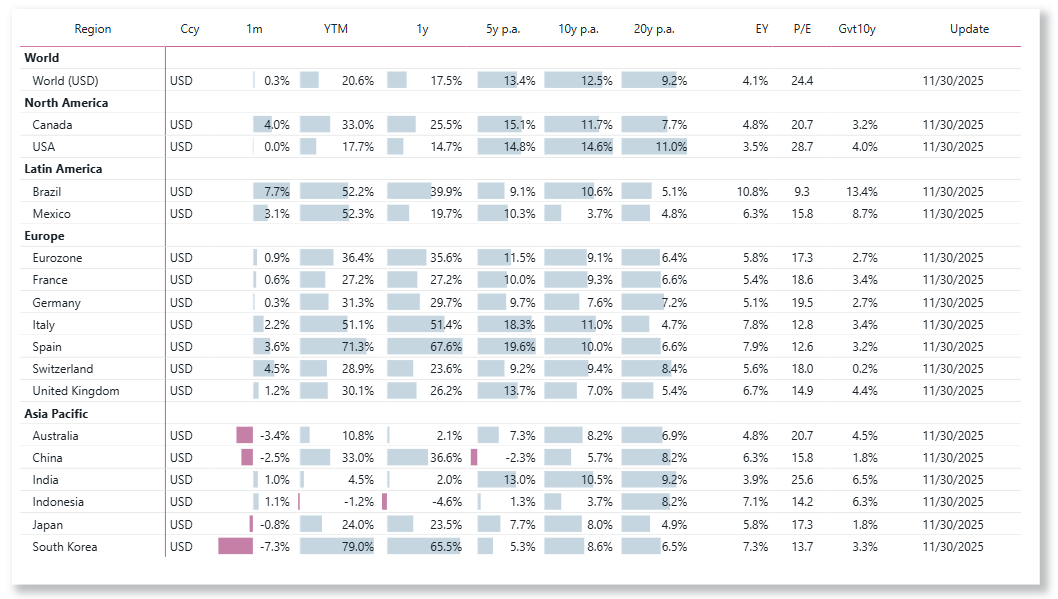
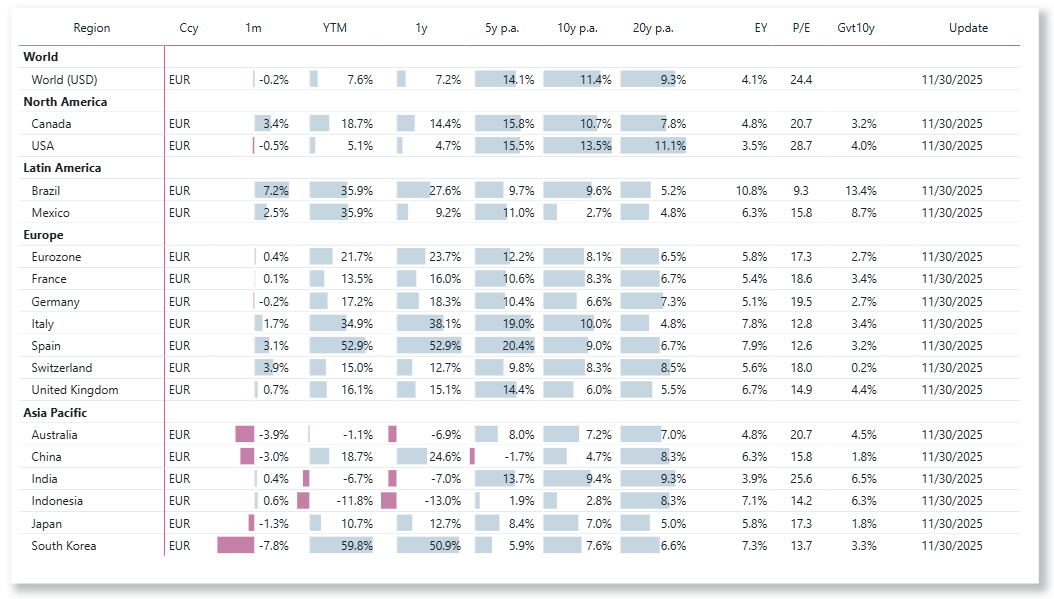
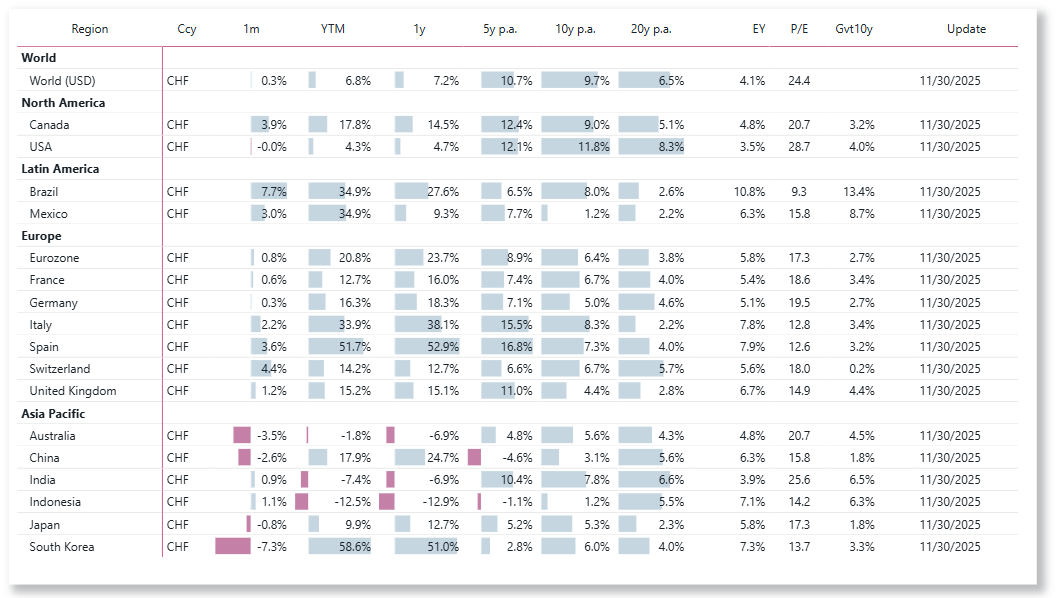
Choose the performance be computed in local currency, CHF, EUR or USD
Equity Performance of Global Sectors
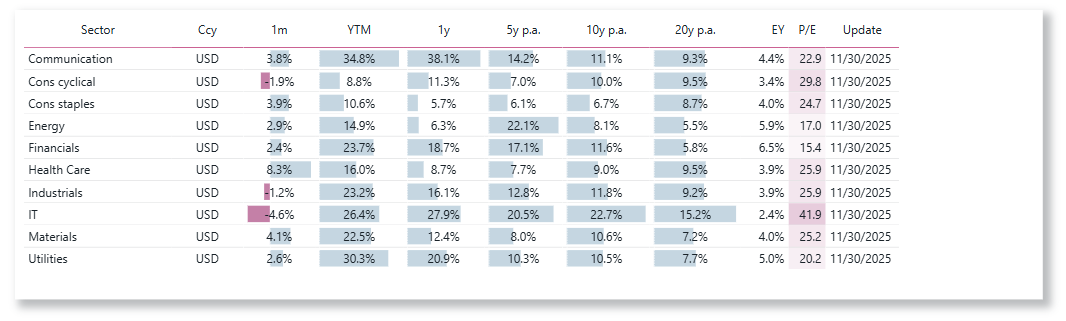
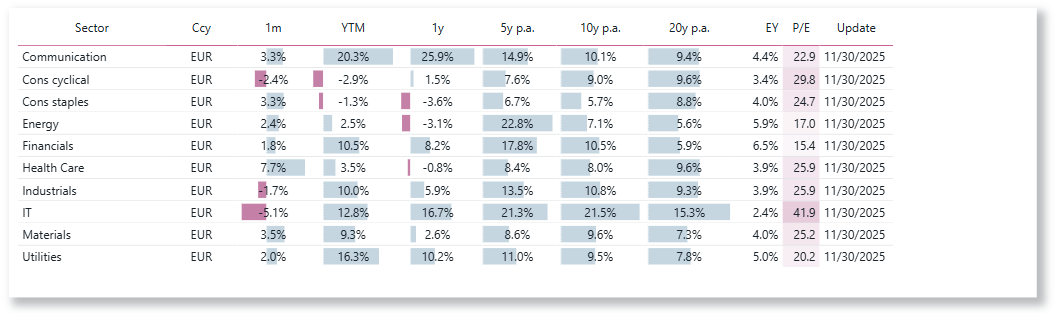
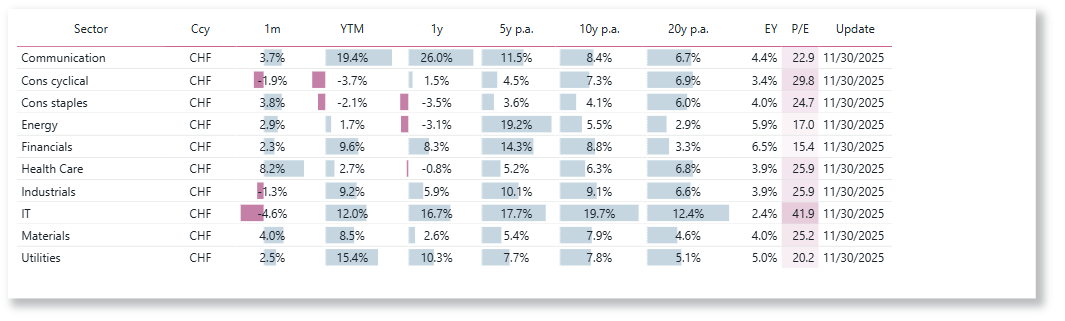
Choose the performance be computed in USD, EUR or CHF
Learn more about LCI Strategies
LCI Strategies Performance update
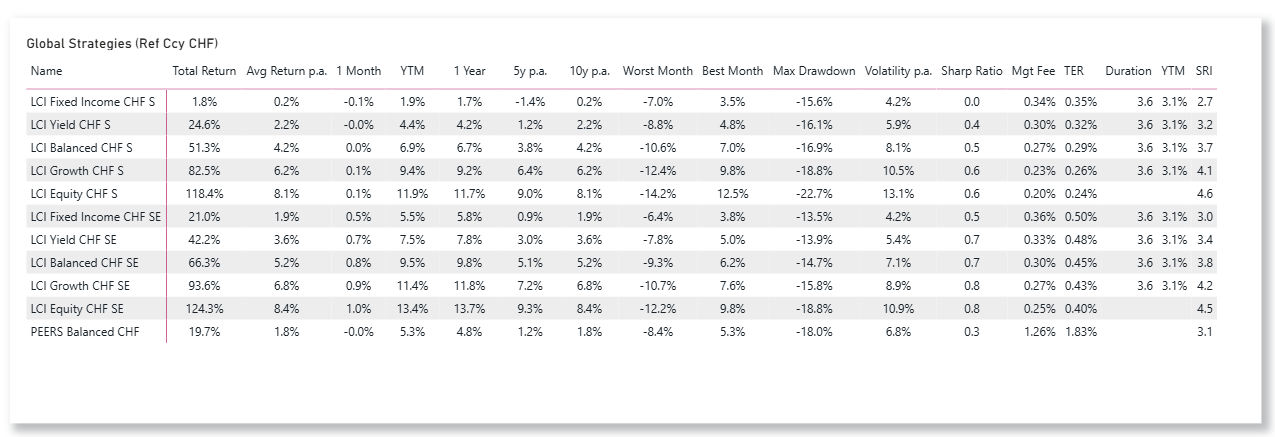
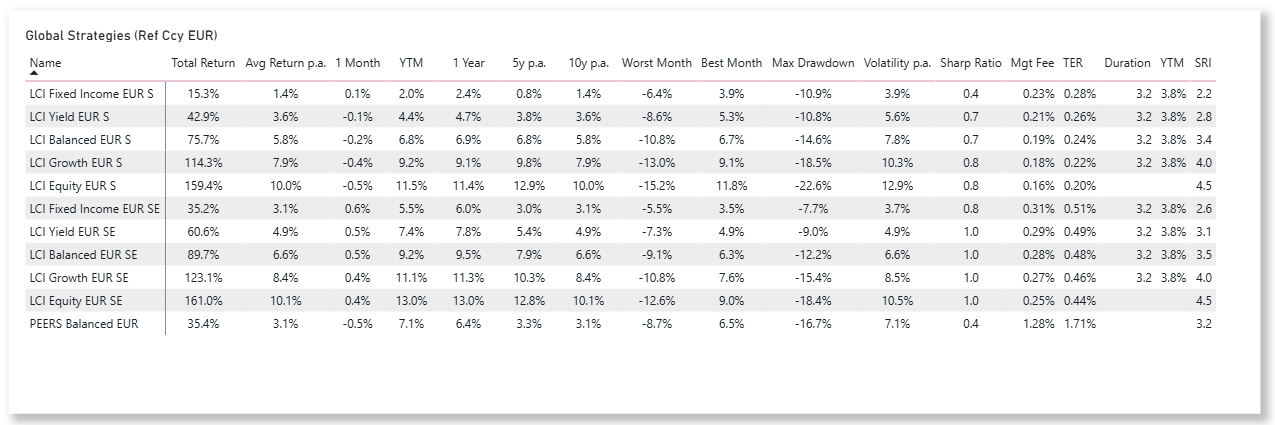
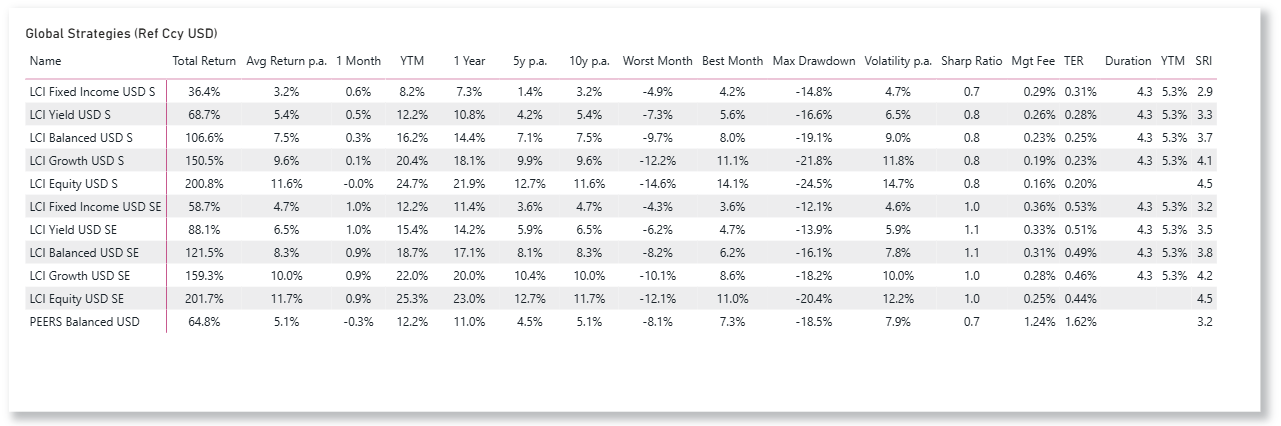
LCI Strategies in CHF, EUR and USD